Institute
louis
Bachelor
louis
Bachelor










By 2050, the climate emergency requires territories to adopt new approaches to anticipate the profound transformations of our lifestyles and our urban environments. This is what the article published by DNA, devoted to foresight as a tool for managing ecological transition.
In this article, Sonia Guelton, member of the scientific committee of the Chair in Economics of Urban Ecological Transition (Real Estate, Housing, Architecture, Development) at the Louis Bachelier Institute, highlights the need for a systemic and long-term vision in territorial planning.
“Imagining the future, without trying to predict it, makes it possible to anticipate events and to put ourselves in a position to act [...]. This makes it possible to identify strengths and weaknesses, to manage over time, to make savings in action and not to react under duress.”
Far from compartmentalized technical approaches, Sonia Guelton calls for a logic of mutual understanding between disciplines and actors. This positioning is at the heart of the discussions carried out by the Chair in Economics of Urban Ecological Transition, which explores the economic, social and spatial levers of a just and sustainable transition.
Read the full article on DNA: https://www.ladn.eu/ladn-transition/anticiper-2050-prospective-au-service-villes-territoires-demain/
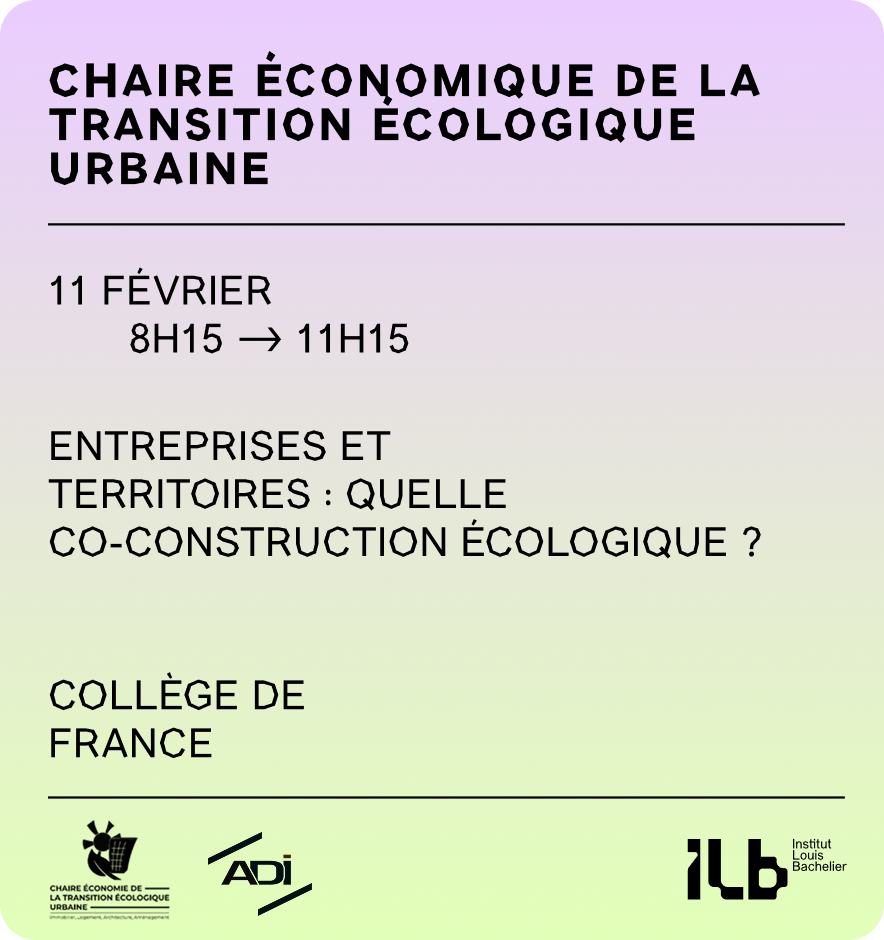
La Chair Economy of Urban Ecological Transition (Real Estate, Housing, Architecture, Development) aims to constitute a reference research and teaching platform on the transformations of the city in the light of climate issues.
Carried by the Risk Foundation at the Louis Bachelier Institute, in partnership with theÉcole des Ponts ParisTech And theÉcole Nationale Supérieure d'Architecture de Paris-Malaquais, it is based on four structural pillars — real estate, housing, housing, architecture, development — in order to bring together actors from the entire value chain of built production.
The Chair adopts a novel transdisciplinary approach, by questioning the economic models of sustainable cities, professional practices and public policies. It aims to breaking down barriers of knowledge and to promote dialogue between architects, economists, urban planners, lawyers, engineers and actors in the real estate sector. It also makes it possible to confront the challenges in the field with academic research, in particular through courses and seminars open to young generations.
By crossing economy, architecture and planning, the Chair proposes new frameworks for analysis and action to think about — and build — the resilient territories of tomorrow.