Institute
louis
Bachelor
louis
Bachelor








An analysis by André Lévy-Lang and Julien Pincet, published in Revue Banque and available here:
https://www.revue-banque.fr/economie/macro-economie/finance-et-multipolarisation-la-monnaie-comme-arme-ME26112691
For a long time, money was seen as a simple medium of exchange. Today, it has once again become what it has always been at certain moments in history: a tool of power.
In their analysis, the authors show how the US dollar, beyond its dominant role, has gradually become a lever of foreign policy and economic sanctions. This evolution is profoundly reshaping the balance of the global financial system.
Contrary to the idea of a shift toward another dominant currency, the current system is evolving toward a more diffuse logic: fragmentation.
Across the world, alternative infrastructures are emerging:
These networks do not replace the dollar. They coexist with it, but make the global system more complex, more compartmentalised, and more heterogeneous.
The figures are clear: the dollar still dominates international payments, foreign exchange markets, and global reserves.
However, its hegemony is becoming less fluid, less natural, and increasingly contested at the margins. The euro remains largely regional, while the yuan is gaining ground without yet becoming a fully global alternative.
The result is an unbalanced system, still organised around a central core.
For the authors, the key issue is not the replacement of one currency by another, but the effects of fragmentation:
In other words: a less “globalised” world, but not necessarily a more stable one.
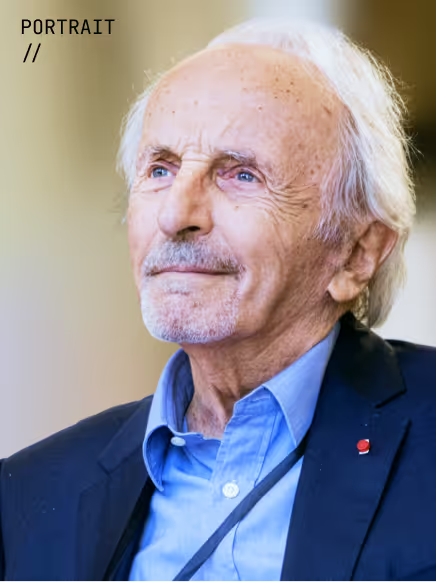
André Lévy-Lang is President of the Institut Louis Bachelier and a leading figure in research on global financial system transformations.
Julien Pincet works on the links between finance and geopolitics within the Geofinance project at the Institut Louis Bachelier, focusing on new forms of monetary rivalry and financial infrastructures.
👉 Read the full article in Revue Banque:
https://www.revue-banque.fr/economie/macro-economie/finance-et-multipolarisation-la-monnaie-comme-arme-ME26112691